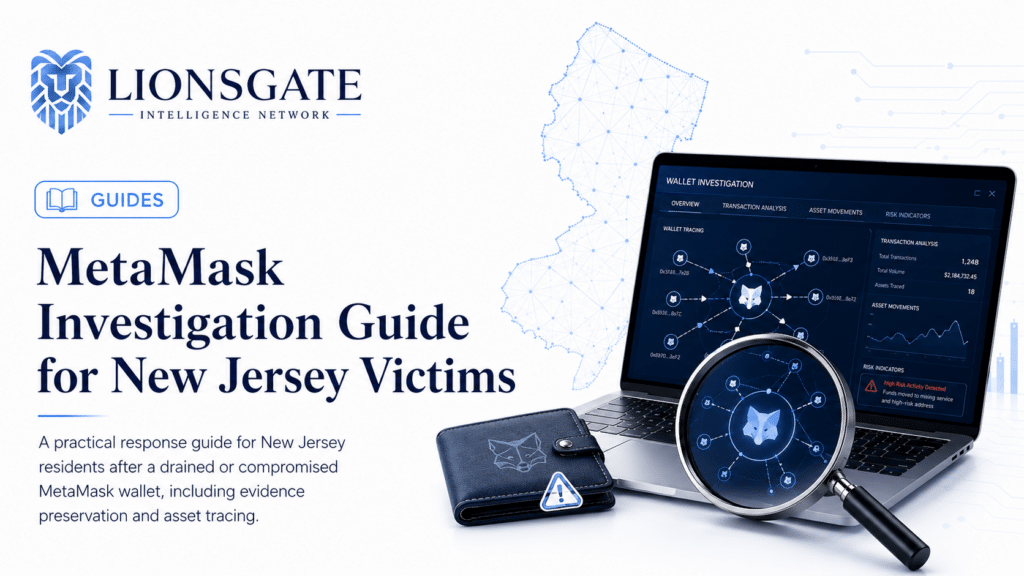
A drained MetaMask wallet can leave a New Jersey resident with little more than a transaction hash and a disappearing website. Whether the incident began with a fake trading platform, phishing link, malicious token approval, or stolen seed phrase, the first objective is not to reverse the transfer. It is to secure what remains, preserve evidence, and identify where the assets moved.
This guide is for residents of Absecon, Asbury Park, Atlantic City, Bayonne, Beverly, and communities across New Jersey who need a practical response after a MetaMask compromise.

MetaMask Scenarios Reported by Victims
Victims often say, “My wallet was drained,” “I cannot withdraw,” or “the platform wants another tax payment.” These cases usually involve one of the following:
- A fake investment dashboard displays profits but blocks withdrawals.
- A romance or Pig-Butchering contact directs the victim to connect MetaMask to a trading site.
- A phishing page captures a seed phrase or wallet credentials.
- A malicious smart-contract approval permits a later token transfer.
New Jersey has pursued enforcement actions involving unregistered cryptocurrency-related investment offerings. The New Jersey Bureau of Securities accepts investor complaints, while the New Jersey Cybersecurity and Communications Integration Cell accepts cyber-incident reports from residents.
Immediate Steps After a Wallet Drain
- Stop sending money. Do not pay a release fee, tax, gas charge, verification payment, or recovery deposit.
- Isolate the affected wallet. Disconnect it from websites and revoke suspicious token approvals. Move remaining assets to a newly created wallet from a clean device.
- Replace the recovery phrase. Never reuse a compromised seed phrase. Do not type it into a website, message, complaint form, or remote-support session.
- Preserve communications. Keep emails, Telegram or WhatsApp chats, social profiles, phone numbers, domain names, advertisements, screenshots, and withdrawal demands.
Victims in Absecon, Atlantic City, Asbury Park, Bayonne, and Beverly should contact the police department serving their municipality. A local report creates a dated record, but state and federal reporting may also be necessary.
Evidence That Strengthens an Investigation
A useful evidence file should allow the incident to be reconstructed without relying on memory. Include:
- The public MetaMask wallet address, never the private key or seed phrase
- Transaction hashes for deposits, theft transfers, swaps, and bridges
- Screenshots of wallet activity and suspicious approvals
- Exchange statements and bank records showing the source of funds
- The fake platform’s domain and wallet deposit instructions
- A timeline showing who made contact, what was promised, and when payments occurred
- Complaint or police report reference numbers
The FBI asks Cryptocurrency Scam victims to report promptly and provide transaction details, communication methods, domains, telephone numbers, and other identifiers. It also warns about recovery services that charge upfront fees.
How Transaction Tracing Applies to New Jersey Cases
A MetaMask investigation follows the assets after they leave the victim’s wallet. The analysis may identify transfers to additional wallets, decentralized exchanges, bridge contracts, stablecoins such as USDT, or deposit addresses associated with centralized exchanges.
Tracing does not guarantee recovery. Its purpose is to identify an actionable destination and present the transaction path clearly enough for an exchange, attorney, insurer, or law enforcement agency to assess.
A stronger opportunity may exist when assets reach a service that can identify its customer and the funds have not moved again.
Where New Jersey Residents Can Report
Depending on the facts, victims may report to:
- Their local police department
- The FBI Internet Crime Complaint Center
- The NJCCIC
- The New Jersey Bureau of Securities for an investment platform, promoter, or financial professional
- The FTC for consumer fraud
IC3 is a federal intake point for cyber-enabled fraud complaints, and the Bureau of Securities provides a complaint process for New Jersey investors.
Mistakes That Can Harm a Case
Do not delete the wallet, overwrite devices, continue paying supposed fees, or give an unknown recovery agent remote access.
Do not share a seed phrase or private key with an investigator, attorney, exchange representative, or recovery provider. A public wallet address and transaction records are enough to begin tracing.
How Lionsgate Intelligence Network Supports New Jersey Cases
Lionsgate Intelligence Network assists New Jersey residents with wallet analysis, transaction tracing, evidence organization, and investigative reporting.
The objective is to determine what can be verified on-chain, whether the assets reached an identifiable service, and what evidence may support further action by an exchange, attorney, court, or law enforcement agency.
A credible MetaMask investigation should separate confirmed findings, reasonable assessments, and unknowns. It should never guarantee recovery.
FAQs
Can MetaMask reverse a stolen transaction?
Transactions on the blockchain are typically not reversible. When an investigation is done, it usually looks at where the assets went and what evidence there is around the loss.
Should I pay a tax to unlock my balance?
Don’t make another payment without checking it yourself. Scammers often ask for money, saying it’s for taxes, fees, or verification. This is common in trading platform cases.
Can a case be traced months later?
Months later, investigators can still look at the blockchain records. The longer it takes the fewer options there are, especially if the assets have been moved, converted, or taken out.
Conclusion
If you live in New Jersey and you find out that someone has taken all the money from your MetaMask wallet, you need to do something about it. Do not send any money; make sure the rest of your money is safe. Keep all the records of your transactions, and tell the people who are supposed to help you about what happened. A MetaMask investigation cannot make a transaction that has already happened go away or promise that you will get your money back. The point of an investigation is to see where your cryptocurrency went, find out if any exchanges were involved, and get all the evidence together for the police, lawyers, or the people who handle your money.