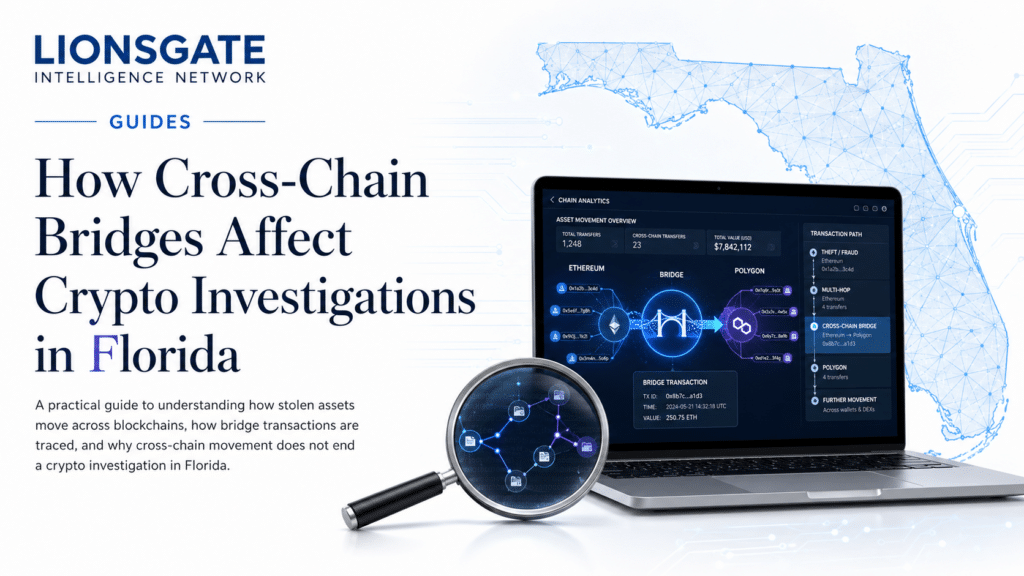
When stolen crypto moves from one blockchain to another, the trail can look like it has ended. A Florida victim may check the original wallet, see the funds enter a contract, and find no obvious outgoing transaction. In many cases, the money has not disappeared. It passed through a cross-chain bridge and continued on another network. This often happens after a wallet drain, phishing attack, fake trading platform deposit, Romance scam, or pig-butchering scheme. Victims in Miami, Tampa, Jacksonville, Orlando, and St.

How Cross-Chain Tracing Works
The asset that appears on the second chain may not have exactly the same name or contract address. ETH may appear as wrapped ETH. A stablecoin may be issued through a different contract. In some cases, the asset is swapped during the bridge process. It may be the same address used on the original network, but scammers often send the output to a separate wallet. From there, funds may be transferred again, exchanged for another token, moved through a decentralized exchange, or deposited with a centralized exchange. The bridge is therefore not the end of the investigation. It is the point where the investigation moves to another blockchain.
Situations Florida Victims Commonly Encounter
A Florida resident may send USDT to what appears to be a legitimate trading platform. The account dashboard shows profits, but the original deposit is quickly transferred, swapped, and bridged to another network. In a wallet compromise, an attacker may drain Ethereum or other tokens from MetaMask, Trust Wallet, or Coinbase Wallet and move the assets across several chains within minutes. Romance and Pig-butchering scams can follow a similar route. The victim is told that the investment remains inside a trading account, while the actual deposits have already been transferred through multiple wallets and services. Recovery scams create another risk. Someone may contact the victim and claim that the funds have been found on a different blockchain. The presence of a bridge transaction does not prove that the caller controls the assets or has the ability to recover them.
Evidence Florida Residents Should Save
Victims should preserve records before websites disappear, accounts are closed, or messages are deleted.
Important evidence includes:
- The original wallet address
- Transaction hashes from every known network
- Token names and contract addresses
- The name or website of the bridge
- Screenshots from the wallet or fake platform
- Messages, emails, usernames, and phone numbers
- Bank, card, wire, exchange, or crypto kiosk records
- Dates, amounts, and withdrawal demands
A screenshot showing a platform balance is not enough on its own. The blockchain records are needed to show where the deposited assets actually moved.

Reporting a Cross-Chain Crypto Scam in Florida
Florida residents should stop sending money as soon as fraud is suspected. Additional tax payments, bridge charges, account-release fees, and recovery deposits are often attempts to extend the loss. If a seed phrase or private key was exposed, the wallet should be treated as compromised. The incident may be reported to local police or the county sheriff’s office, the FBI Internet Crime Complaint Center, the Florida Attorney General, and the Florida Office of Financial Regulation when financial services or investment activity is involved. A useful report should include the original transaction hash, destination wallet, amount, token, date, platform name, and any known bridge or exchange involved.
FAQs
What does it mean when the trail leads to a smart contract?
A transaction involving a bridge, routing protocol, or swap service will often interact with a smart contract. Rather than a dead end, this point often provides event logs and contract records that identify the subsequent destination wallet and network where the assets emerged.
Does a cross-chain transfer mean the crypto was cashed out?
No. When you use a bridge to move crypto from one blockchain to another, that is all it does. It does not mean the crypto was sold for cash. The crypto might be sent to an exchange later. It might be converted into cash, but the bridge transaction itself does not show that the crypto was sold.
What information should a Florida victim include in a report?
If you are a victim in Florida, you should include some information in your report. It can also be helpful to include screenshots, messages, and any payment instructions or withdrawal demands you received. All of this information can help the IC3, local law enforcement and investigators follow the movement of the funds and try to get your crypto
Conclusion
Cross-chain bridges can make stolen crypto harder to follow, especially when the victim is looking only at the original blockchain. The key is to identify the bridge, match the source transaction with the destination-chain activity, and continue tracing from the receiving wallet. Florida residents dealing with a fake trading platform, wallet drain, phishing attack, or relationship-based investment scam should preserve every available transaction record and stop sending additional payments. Lionsgate Intelligence Network reviews bridge activity, token swaps, wallet movements, fake-platform records, and victim communications to help Florida clients understand how their assets moved and what investigative steps may still be available.