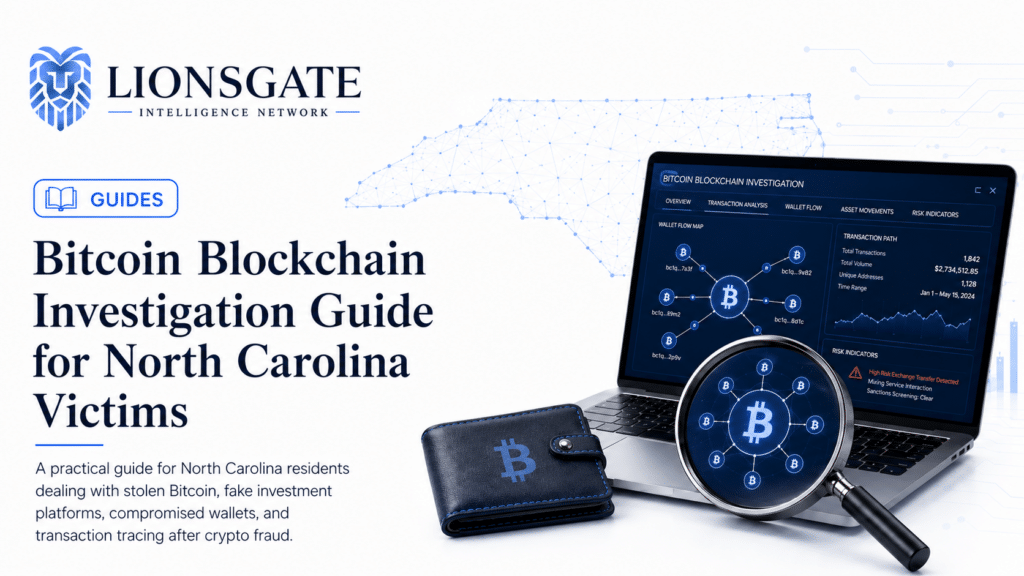
When Bitcoin is stolen, sent to a fake investment platform, or transferred from a compromised wallet, North Carolina victims often have one main question: where did the money go? A Bitcoin blockchain investigation can help answer that question. It cannot cancel a confirmed transaction or guarantee that funds will be returned. Its purpose is to follow the transaction trail, identify possible exchange involvement, and organize evidence for the people or institutions that may be able to act. This guide is written for residents of Charlotte, Raleigh, Greensboro, Durham, Winston-Salem, and other communities across North Carolina.

Bitcoin Fraud Cases Seen in North Carolina
Many cases begin with a person who appears friendly, helpful, or financially successful. Problems begin when the victim tries to withdraw the money. The platform may demand a tax, verification charge, commission, security deposit, or account release fee. Paying usually leads to another demand. Other North Carolina victims lose Bitcoin after clicking a phishing link, installing a fake wallet application, sharing a seed phrase, or allowing someone to access their phone or computer remotely. In some cases, the first scam is followed by a recovery scam. A company claims that it has already found the stolen Bitcoin but requires an upfront payment before it can release the funds.
What a Bitcoin Investigation Can Find
When we start a Bitcoin investigation, we look at the transaction that took place, not just the balance that is shown on a website. The person doing the investigation checks the transaction ID. Then follows the Bitcoin as it moves from the victim’s wallet or exchange account. The Bitcoin might go to one address, or it might get split up between several different wallets, or it could go through a bunch of transfers. The investigation might also show that the Bitcoin ended up at an exchange or some other service that has records of its customers. This is important to know because just having a wallet address does not tell us who is really in control of it. If we want to get information about the customer, we usually need the service to cooperate with us, or we need to get law enforcement involved or we need to go through a process. Tracing Bitcoin creates a record of where it has been. It does not give a private investigator the power to freeze an account, take control of the cryptocurrency, or force an exchange to give us information about its customers.
What North Carolina Victims Should Do First
Stop sending money as soon as you suspect fraud. Do not pay another tax, release fee, verification charge, or recovery deposit. Secure the email account, exchange account, and wallet connected to the incident. Change passwords, enable multi-factor authentication, and remove devices or sessions you do not recognize. If a seed phrase or private key may have been exposed, move any remaining assets to a new wallet created on a clean device. Do not reuse the compromised recovery phrase. Contact the exchange or payment service used to buy or send the Bitcoin. Give them the transaction details and ask for the matter to be reviewed by the fraud or compliance team. It is also useful to write down the full sequence of events while the details are still fresh.
Evidence That Can Help
Keep the information in one folder so the case can be reviewed without relying on memory:
- Bitcoin transaction IDs, wallet addresses, dates, amounts, bank records, exchange statements, screenshots, website links, phone numbers, email addresses, usernames, advertisements, and chat messages.
Include a simple timeline explaining how the contact began, what the person promised, when each payment was made, and when you realized something was wrong. Never include your private key, password, or seed phrase in an evidence file. A legitimate investigator does not need those details to examine public Bitcoin transactions.
How the Investigation Is Carried Out
The first step is confirming the real transfers. This is especially important in fake trading platform cases because the profits shown on the screen may never have existed. The final report should explain what was confirmed, where the Bitcoin moved, what services may be involved, and what remains unknown. It should also make clear which findings are based on public transaction data and which require further records. A report may be useful to an exchange, attorney, insurer, police department, or federal agency.
Reporting Bitcoin Fraud in North Carolina
Victims in Charlotte, Raleigh, Greensboro, Durham, and Winston-Salem can report the incident to the police department or sheriff’s office serving their area. Online Cryptocurrency Fraud may also be reported to the FBI Internet Crime Complaint Center. If the loss involved a fake investment opportunity, unregistered promoter, or fraudulent trading platform, the matter may also be reported to the North Carolina Secretary of State Securities Division. Consumer fraud complaints can be submitted to the North Carolina Department of Justice. When filing a report, include transaction IDs, wallet addresses, payment dates, amounts, website domains, phone numbers, usernames, and copies of communications. A report does not guarantee that funds will be recovered, but it creates an official record and may help connect the incident to other complaints.

How Lionsgate Intelligence Network Supports North Carolina Cases
Lionsgate Intelligence Network assists North Carolina victims with Bitcoin transaction tracing, wallet analysis, evidence organization, and investigative reporting. The purpose is to determine where the Bitcoin moved, whether it reached an identifiable service, and whether the available evidence supports further action. The findings should be clear, verifiable, and realistic. No responsible investigator should guarantee that stolen Bitcoin will be recovered.
FAQs
Can a Bitcoin transaction be canceled?
No. Once the transaction is confirmed, it cannot normally be reversed. The investigation focuses on where the Bitcoin was sent.
Can Bitcoin still be traced after several months?
Yes, you can still review the transaction record. If the funds have moved through many wallets or been withdrawn from an exchange, delays might limit your options. The transaction record is still accessible for review. However, the more. Exchanges involve fewer options than you might have due to delays. You can check the record.
Is a transaction ID enough to start?
A transaction ID can provide the starting point. Wallet addresses, exchange records, screenshots, dates, and communications can make the investigation more useful.
The Bottom Line
North Carolina victims should stop sending money, secure affected accounts, preserve every available record, and report the incident promptly.
A Bitcoin blockchain investigation cannot promise recovery. It can show where the funds moved, identify possible exchange involvement, and provide an organized record for further legal or investigative review.