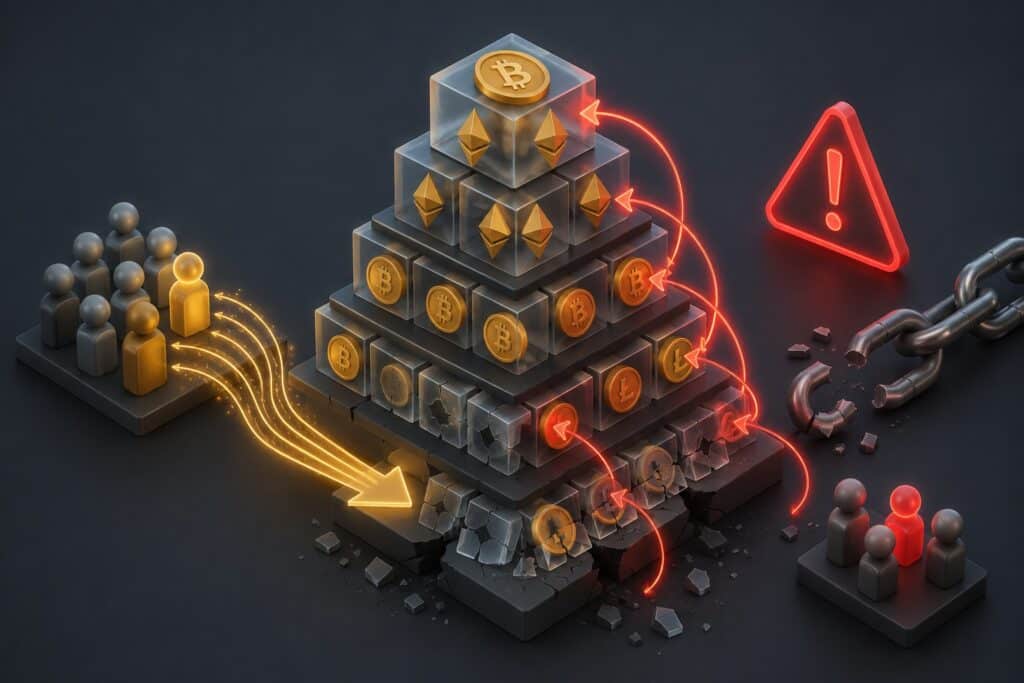
A crypto Ponzi scheme is defined as a scheme based on deception where the money from new investors is used for paying the investors who joined earlier rather than making genuine profits on the investment.
One of the features of crypto that makes such schemes difficult to spot is that they look legitimate due to the professional design of the website, terminology used, charts, and promises of automated gains.
Those investors who begin to look at the new types of investments such as crypto find it vital to understand the difference between the genuine risk of the market and investment fraud.
How Does a Crypto Ponzi Scheme Work?
The essentials operate far less complicated than one expects from the technology.
The promoter entices investors by luring them in with promises of high returns. Rather than have the returns come from activities such as legitimate trading, lending, mining, or any other profitable business. The promoter takes the money received from new participants to pay back old investors and to maintain the illusion of a real scheme as long as new money keeps on flowing in.
It all boils down to a simplistic cycle: new investors → new deposits → payouts to earlier investors → increased trust → recruitment → the scheme collapses
Is Crypto a Ponzi Scheme?
No, cryptocurrency is not a Ponzi scheme per se.
Cryptocurrency is an umbrella term which consists of various cryptocurrencies and blockchain projects with different systems, uses, risks, and rules. Nevertheless, scammers can conduct a Ponzi scheme using cryptocurrency.
This distinction is important while assessing investment opportunities. Instead of asking if “crypto” is authentic, investors should ask the following questions:
- Where does the promised profit come from?
- Is the company or investment registered where it has to be registered?
- Can investors get their money back without restrictions?
Many legit businesses are risky but Ponzi schemes are very different – their returns are based on illegal movement of funds.
Crypto Ponzi Red Flags Investors Should Not Ignore
| The signs of a warning signal | Reason to be alert |
| Profits as guaranteed returns | Real investment will never get rid of the market risk |
| Profits will be earned all the time, independent of market situations | True methods will be subject to fluctuations |
| Pressure to involve others | Possibility of new payments to be taken as the basis for the scheme |
| Delays of withdrawals and other hidden fees | Can indicate the shortage of money |
A commonly ignored signal is complexity without verifiability.
The promoter can be talking about proprietary algorithms, artificial intelligence trading, arbitrage systems, mining infrastructure, or advanced DeFi strategies. The use of sophisticated vocabulary does not mean that whatever is being discussed exists.
Investors must look for independently verifiable evidence rather than attractive vocabulary.
Crypto Ponzi Scheme List: What Investors Can Learn From Past Cases
It is impossible to fully ascertain whether a particular cybercurrency scheme is fraudulent due to the fact that cybercriminals are clever and often change names, web visits, and launch new tokens to avoid being caught. However, past experiences will show one that certain patterns are common for Ponzi schemes.
For example, BitConnect is among the biggest Ponzi schemes relating to cybercurrency. The SEC alleges that investors were told to expect earnings through a unique Bitcoin trading platform that used investors’ funds in a bigger fraud.
The SEC has also pursued fraud schemes that involved promises related to investments coupled with aggressive recruitment. This means that even though technology and names could be different, the model of fraud remains the same.
For the sake of research, investors should rely on official databases of fraud investigations and publicity rather than unofficial “scam lists.”
What If You Have Already Invested in a Crypto Ponzi?
Make sure not to send more bitcoin because someone tells you that you have to pay taxes, an authentication fee, a liquidity fee, a withdrawal fee, or upgrade your account before getting your money. Making a second payment may turn the money lost from the first investment into an even bigger loss.
Collect evidence before all websites, accounts, and messages are gone forever. Save the following information:
- Wallets
- Transaction ids or hashes
- Exchange records
- Screenshots of the account balances and efforts to withdraw the money
- Investment contracts
- Banking statements
If there was a transfer of cryptocurrency, blockchain transaction history can also be useful. Blockchain tracing does not mean that we will get your money back. However, we can see how your crypto moved from one address to another.
Lionsgate Network offers crypto fraud investigation, blockchain tracing, asset recovery solutions, and law enforcement support. These services are of special importance if a Ponzi scheme is being conducted with the use of crypto.
How to Recover Money Lost to Task Scams and Crypto Investment Fraud
Some task scams could be construed as a part of the bigger scheme of cryptocurrency Ponzi fraud. Fraudsters promise clients the commissions for completing a given number of tasks while requiring them to make the initial deposit in cryptocurrencies in order to get access to more lucrative offers or to withdraw their money.
If you look for tips on how to recover money lost to task scams, the first thing you need to do is avoid paying money to another fraudulent “recovery” company. Gather all the evidence first, and find out where exactly your money went.
How to recover money lost to task scams may involve many parties, depending on the payment service that was used, the legal environment of the transaction, and the history of the transaction. Financial institutions, cryptocurrency trading platforms, and law enforcement authorities might all have different roles in the process.
Protecting Yourself Before Investing
Do not make investment decisions based on balance sheets, social media followers, endorsements from influencers, or testimonials of others claiming to have made money.
The best practice is to confirm the corporate identity of the asset, the named individuals behind it, its investment strategy, regulatory status if any, custody and withdrawal policy, and how returns are generated.
A good principle to remember is the following:
If you cannot in your own words explain how the asset you are investing in generates returns, you do not have enough information to invest yet.
This rule applies regardless of whether the project is about Bitcoin or another form of cryptocurrency, DeFi, staking, automated trading, tokenized asset, etc.
Frequently Asked Questions
1. Which signs point to the fact that one might be involved in a crypto Ponzi scheme?
High or guaranteed return, stable profits, pressure to attract other investors, withdrawal issues, lack of information about the investment process and demand for additional payments are among the most common telltale signs of a crypto Ponzi scheme.
2. Can one get money back from a crypto Ponzi scheme?
In some cases on how to recover money lost to task scams is possible, although not guaranteed. The process of recovery depends on the history of transactions, evidence from the blockchain and some other factors.
3. How to find a list of crypto Ponzi schemes?
It is advisable to check the databases used by regulatory authorities rather than any unofficial lists found on the Internet as a scheme might operate under different names and therefore investors should pay attention to its business model.